Tuesday, April 29, 2014

The Black Pacific in All Universes

Currently in an International CyberPunk Literature class, we are reading a novel called Terraplane. In it, an American duo of special agents (one a former military man named Luther) kidnap a brilliant young Russian scientist in order to find her mentor who has gone missing leaving a huge question about his mysterious work. The year is 2056 and there have been many wars since 1988 (when the novel was written). After the expedition goes wrong, Oktobriana, the young Russian scholar, has no choice but to use the mysterious device and they find themselves in 1939 New York, crashing into a swamp. Rescued by a black doctor, they learn that they did not travel back in time but rather to another alternate universe in which history seems very similar but not identical. For instance, slavery was abolished by Teddy Roosevelt in 1901.

It is through many new experiences of discrimination that we learn that Luther is black, a fact which was barely noted upon in his nearly post-racial apocalyptic 2056. Initially absent, race plays a growing role in the novel (when Luther is harassed by a group of Irish immigrants, he complains to the police who break his ribs). While WW2 has not yet occurred in this different world, the seeds of the Black Pacific have already been planted and some parallel images bring the two world closer. In one moment, Luther describes to Wanda, the doctor's wife, what will happen in the future:

" 'You know the future, Luther. What am I going to miss?'
'This September, Hitler invades Poland,' I said, deciding for folklore's sake to follow our world's chronology. 'Starts World War Two. Conquers most of Europe. Sets up death camps. Kills millions of Jews. Many know but none act-- '
'Figures,' she said. 'Haven't there been enough dead already?'
In God's plan, I doubted Hitler had ever had a cold.
'Fighting HItler's like makes us forever more like the fought.' I continued. 'We abyssgaze overlong. That's Europe. Another front opens in the Pacific. Japan attacks Hawaii in late 1941 with planes built' -- I had to laugh, remembering now-- 'with scraps of the Sixth Avenue el. A bomb--'
'Japs?' she asked. 'Good.'
'Good?'
'They're colored people,' she said. 'True?' " (Womack, 195)

Even in an alternate universe, slavery occurred and lasted much longer. Japanese propaganda seems to also have reached jaded Black Americans, former slaves on what became the state of Cuba. The struggle of white imperialism versus native and colored peoples of the world has so marked our 20th century that for Womack, it was not an option to change it. The world as we know it would be unrecognizable without it, and this near recognition is a crucial plot point in Terraplane.

Another passage brought to mind the political cartoon entitled "The Harvest in the Philippines" (page 109 of the text, 265 of the reader) and the implications that dead bodies are harvested, that war is a producer of death and assimilation and that people are commodities is referred to in Terraplane as well. Luther, a former high ranking officer of the army has flashbacks about his time in the field. In one particular touchy campaign, Luther had to kill children. A sudden fit of exhaustion brings the memory of burying all the children back to him:

"As I watched I recalled the rest, unable to contain the flood. Three [children] remained to be planted and I chose to be their farmer" (Womack 209).

The bodies of the future children of Long Island are, like the Filipinos of the cartoon, dead seeds to be planted in an orderly fashion by the US army, however unwitting they may be. Here, the near post-racial qualities of Luther's life make him feel closer to the children, not because as a member of a minority, he identifies with them, but because he mourns their lost childhoods. But the image of the farmer, plucking life from his victims is in both cases stimulated by American imperialism over an island which did not want to follow orders set by the US.


Works Cited
Womack, Jack. Terraplane: A Novel. New York: Weidenfeld & Nicolson, 1988. Print.

Monday, April 28, 2014

Made in China

Frederick Douglass did a great job at pointing out how the coolie trade is merely an evolution of the African slave trade, "kindred in character and results". As I continued to reflect on the matter, it occurred to me that the coolie trade has evolved to take another form, where instead of shipping the laborers overseas, we ship the labor. Of course cheap labor continues to be imported into the US, but the market dynamics on a global scale changed drastically once manufacturing companies began moving overseas. This maneuver has become an important part of the ongoing modernity discourse insofar as cheap labor, feeding the "lust for gain", as put by Douglass in his editorial.

The link below further elaborates on the current trends of cheap labor in a market that has complex interdependency. As said by the narrator, "That's the basic engine of today's global economy: cheap labor. Either it migrates to where the work is, or the work migrates to where there is an abundant supply of cheap labor."https://www.youtube.com/watch?v=L2m4ogCvOW4

Mark Twain and U.S Imperialism

I have researched and uncovered a couple newspaper articles in which Mark Twain directly criticizes and voices his own political views to the American public. Hopefully, we will be able to discuss these sources in comparison with Twain's presence in Howard Zinn's "The Invasion of the Philippines." Admittedly, I was humbly shocked upon learning that Mark Twain was such an Anti-Imperialist, let alone a member of an official league. Also, his critique on the Godly righteousness of the American military struck me as interesting, due to Twain's popularity as a satirical author who gave his country 'The Great American Novel," Adventures of Huckleberry Finn. The importance that a literary figure can possess over one's culture is heightened and exemplified in Mark Twain's historical recording of events, such as the Moro Massacre, which otherwise would have been swept up and censored by the American government.


 The New York Herald (October 15, 1900)

"I left these shores, at Vancouver, a red-hot imperialist. I wanted the American eagle to go screaming into the Pacific. It seemed tiresome and tame for it to content itself with he Rockies. Why not spread its wings over the Philippines, I asked myself? And I thought it would be a real good thing to do.
I said to myself, here are a people who have suffered for three centuries. We can make them as free as ourselves, give them a government and country of their own, put a miniature of the American constitution afloat in the Pacific, start a brand new republic to take its place among the free nations of the world. It seemed to me a great task to which had addressed ourselves.
But I have thought some more, since then, and I have read carefully the treaty of Paris, and I have seen that we do not intend to free, but to subjugate the people of the Philippines. We have gone there to conquer, not to redeem. . .
It should, it seems to me, be our pleasure and duty to make those people free, and let them deal with their own domestic questions in their own way. And so I am an anti-imperialist. I am opposed to having the eagle put its talons on any other land."


"To the Person Sitting in Darkness" (February 1901)

"There must be two Americas: one that sets the captive free, and one that takes a once-captive's new freedom away from him, and picks a quarrel with him with nothing to found it on; then kills him to get his land. . .
True, we have crushed a deceived and confiding people; we have turned against the weak and the friendless who trusted us; we have stamped out a just and intelligent and well-ordered republic; we have stabbed an ally in the back and slapped the face of a guest; we have bought a Shadow from an enemy that hadn't it to sell; we have robbed a trusting friend of his land and his liberty; we have invited clean young men to shoulder a discredited musket and do bandit's work under a flag which bandits have been accustomed to fear, not to follow; we have debauched America's honor and blackened her face before the world. . .
And as for a flag for the Philippine Province, it is easily managed. We can have a special one--our States do it: we can have just our usual flag, with the white stripes painted black and the stars replaced by the skull and cross-bones."

Also, here is a link to another blog I found, which discusses the publishing of Twain's autobiography and his attack on U.S Imperialism. There is a video on this page which I found interesting to watch, due to its brief but direct commentary on the "Moro Massacre" we discussed in class.

 "The Last, Lost Empire"


-Jessica St. Martin
4-27-14

Sunday, April 27, 2014

Nahko Bear's music as a representation of cultural intersectionality and brutality to minorities in the Pacific

    Recently I've discovered an up and coming artist whose group goes by Nahko and Medicine for the People, and when doing solo performances he goes by Nahko Bear. Nahko's music is positive, honest, and transmits intense cultural pride. He states in his biography on his website that he is "born a mix of Apache, Puerto Rican, and Filipino cultures, and adopted into an American family" in the state of Oregon. I feel he is a perfect example of the cultural intersectionalities associated with the Pacific region, and I wanted to share a couple of powerful and heavily cultural influenced songs he has and bring them into context with our recent discussions (as well as introduce you all to some beautiful music you may or may not have heard before).

The first is titled "My Country" off of the album Dark as Night
My Country Nahko audio
The song opens with a Native American chant, dubbed over with a quote from John Trudell stating "We feel that racism and sexism and class separation - that these are desecrations, and we feel the american flag does not represent integrity, honor, justice, or truth." It then goes on in the same style as the commonly known patriotic tune "My Country 'Tis of Thee" singing altered lyrics reminding the listener of the corruption present in the United States of America's history. Keeping in mind his Apache roots, its fair to interpret the lyrics of genocide, industry, climate suffering, and specifically the second to last stanza singing of "our people left to die / battlefield countryside / ... / suburban villages / make desolate villages / broken treaties / broken promises / conquer repeat, repeat, repeat" as references to personal or closely personal experiences. The song's lyrics are brutally honest, depicting saddening images of the results of America's greed.

The second song is titled "So Thankful" off of the album Dark As Night
So Thankful Nahko audio


This song has emotionally painful lyrics with a strangely uplifting beat and positive chorus. The lyrics depict an extremely difficult family history filled with anecdotes of negative experiences that seem related to destructive effects on the Native American and Filipino peoples that have been caused by the poor conditions they were living in as a result of decisions made by the American government. In class we've discussed the Moro massacre of Filipino people also known as the Battle of Bud Dajo that occurred in 1906, a massacre that occurred out of the American government's desire to make the Philippines "a stepping-stone to China." In this song, Nahko sings of his great grandfather who "got shot in the back / protecting Filipinos / from the corporate attack." Now obviously there is no way of knowing if it was this particular massacre that Nahko speaks of  but regardless it is a relevant idea of Filipino men who get killed trying to protect others from corporate greed and imperialism due to economic interest. However, Nahko turns these experiences around, claiming how grateful he is for these experiences because they helped create the man he is today, and help him to spread truth and awareness.

I hope you enjoyed these songs, and I recommend listening to his other songs if you'd like to hear more! My personal favorites are "Black as Night" and "Aloha Ke Akua" which are also off of his Dark As Night album.

Sunday, April 20, 2014

A Threat to Citizenship

Reading, and re-reading, U.S. Supreme Court case Plessy vs. Ferguson and reflecting about our Thursday conversation in regards to the court case I couldn't help relate the case to citizenship and identity politics. The question that continues to intrigue me is how does Plessy's identity (appearing anglo and having phenotype white feature, but marked as a Black man) challenge citizenship and the dominant ideology of the national identity? Declared the law of the land, the 13th amendment abolished slavery and attempted to free black people and their decedents from the bondage that they had endured; and combined with the 14th and 15th amendment, the Reconstruction Amendments sought to introduce Black people to privileges that had been reserved for whites since the introduction of African slavery in North America (to my knowledge at least). While legislation existed to introduce Blacks to: full citizenship, "equal rights," and "equal" protection, society was unprepared to embrace these new changes and expand the ideology of who was perceived as a citizen and who was not. This idea is reflected in the final decision of Plessy vs. Ferguson where the Supreme Court ruled that the separation of races did not go against the 14th amendment if the races were treated equally.

For its time citizenship is most challenged in regards to physical appearance, in particular skin color. While the 14th amendment extended federal citizenship to Blacks above state citizenship, Blacks continued to be seen as inferior people. In Plessy vs. Ferguson Justice Henry B. Brown wrote the majority opinion upholding the separations standards of the South and consistently framed Blacks in positions of servitude and criminality stating, "A white man is not permitted to have his colored servant with him in the same coach, even if his condition of health requires the constant personal assistance of such servant." This image constrains Blacks from being seen as anything else, let alone work in positions that their white counter parts worked. While this framing may have been made unconscious, this image creates a binary between access and disadvantaged. A large majority of white people did not work in positions of servitude, and if they have been the dominant citizenship then it is hard for the dominant class to see Blacks as anything else. 

I believe that Plessy is a threat to citizenship and the national identity because his physical appearance blurs the idea of citizenship. If a black man that appears white, is 1/8's Black then who else potentially can be black? Could black men have been benefiting from the privileges whites had. If so how does the United States continue to segregate without breaking the law? The answer is creating "separate but equal facilities that treat both races the same" and prevents contact of the two identities. While the question turns to equality vs. equity, The Jim Crow Laws were enforced to institutionalize Blacks into second class citizenship and prevented the national identity to extend to them.

Thursday, April 17, 2014

Benito Cereno

While reading Melville's short story, "Benito Cereno," a specific passage caught my interest and brought a question to mind. This excerpt is on page 55 of the Reader, page 38 in the novel, and displays the estrangement that followed slave ships throughout "the blank ocean." Melville describes this experience as being a "living spectacle" in "a strange house with strange inmates in a strange land." Starting with the sentence, "Always upon first boarding of a large and populous ship at sea..." and finishing with "... which directly must receive back what it gave," this passage places the human cargo, forcibly crushed into corners of disease and death, in comparison with "something of the effect of enchantment," and "in contrast with the blank ocean." This description allows the awareness that the slave trade is not a calm and smooth travel, but avoids the reality of its true horror. In fact, the passages use of the words "enchantment," "unreal," and "a shadowy tableau" further distance the realities of slaves arriving in America. The repeated use of 'strange' as a description of the ship, cargo, and destined land dilutes actual concentration of disease, hunger, pain, and vehement chaos that culminated within "large and populous ships at sea." Closely examining the literature produced during the era of slavery in America allows us to see the powerful extent that economic interest and gain had over the small percentage of free and powerful men that left thick trails of blood amid the churning wake of their journey towards wealth.

-Jessica St. Martin

Monday, April 14, 2014

Desegregation in Schools: Brown v. Board of Education

https://www.youtube.com/watch?v=TTGHLdr-iakAs we discussed in class, the military was desegregated before schools were, but undoubtedly, the desegregation of the military acted as a precursor for schools to evolve in the same manner. While searching the web for video content on the desegregation of armed forces, the impression I got about what these videos were promoting was that what fueled this movement were honorable feelings of equality and unity, and the portrayal of President Truman was of a saint for having authorized desegregation. I feel that these views are a bit romanticized and that the desegregation of armed forces was fueled by necessity more than any other factor.

Regardless of the factors that fueled the desegregation of the military, it initiated a trend that would be hard to ignore outside of the military environment. It was hypocritical to have soldiers return to a civilian reality that was "separate, yet equal". The link below briefly runs through the historical content of Brown v. Board of Education; the ruling that initiated desegregation in schools, which concluded that "separate, but equal" had no place in the American Constitution.

Dominant Forms of Oppression to Liberate from Oppression

While I have read Herman Melville's Benito Cereno in the past, it has been surprisingly refreshing to experience the novela through a different lens. The first time I read it was for a class assignment where many of my peers victimized the Spaniards and demonized the slaves for taking over the ship. What I now consider "brave" acts of resistance, at the time I did not care that the actions of the slaves were being contested. Today, the actions of the slaves carry validity and act as a testament that Black bodies that were enslaved in fact were smarter than what they were portrayed. With that said, it has been conflicting to validate the actions of the slaves while acknowledging that they are perpetuating dominant forms of oppression that reflect the actions of those that captured them. This point leads me to my question: While scholar activists such as Paulo Freire states "In order for this struggle to have meaning, the oppressed must not in seeking to regain their humanity become in turn oppressors of the oppressors, but rather restorers of the humanity of both" (Freire 28,) would it be possible for an enslaved human to achieve liberation on the Atlantic without embracing tools from the oppressor's box? To be honest, I'm not sure.

Captured slaves on the Atlantic are in an interesting situation because they exist on water, and something concrete such as a ship. Traveling in the past was radically diffferent in comparison to today and one could spend anywhere between 2-4 months. This granted slaves very limited opportunities to free themselves from bondage because they were surrounded by a body of water that could potentially engulf them if something went wrong, while they remained on something concrete (a ship) that constrained them while attempting to mold them into the new identity of slave. Captured slaves had limited options to achieve freedom, and if they were to try and have it, they had to become aggressive. In We Real Cool: Black Men and Masculinity Bell Hooks claims that Africans were not aggressive beings, but rather very gentle. She claims that the slave trade inevitably led to African/Black men becoming more aggressive and embracing dominant forms of oppression to gain a false sense of independence (Hooks 11). Therefore in order to begin to change the power dynamics, slaves have had to take on new characteristics in attempt to gain freedom. For instance in Benito Cereno, the slaves on board use settle ways to apply intimidation (I say use instead of create because the oppressor has already used these tools against the oppressed. The oppressed is now using that tactic against the oppressed). Physical tools such as a rope, a lock, and a shavers knife are all used to remind the Spaniards of what the slaves are capable of doing if they ruin the plans. I would love to talk about this subject more at length in class to get other opinions into the conversation!

Freire, Paulo. Pedagogy of the Oppressed. 26. New York, New York: The Continum Publishing Corporation, 1987. 186. Print. 
Hooks, Bell. We Real Cool: Black Men and Masculinity . New York, New York: Routledge, 2003. 160. Print.

Slavery: The Empire of Necessity

One of the things we discussed in class was Greg Grandin's article, The Empire of Necessity: Slavery, Freedom, and Deception in the New World, and more specifically, we discussed German Philosopher G.W.F. Hegel's analysis of slavery from The Phenomenology of Spirit, which Grandin speaks of in his article. Using parts of Grandin's introduction to The Empire of Necessity: Slavery, Freedom, and Deception in the New World, as well as the part entitled, "South Sea Dreams," I want to analyze this idea of a necessity of the other (for the master, the necessity of the slave, and for the slave, the necessity of the master), and use this theory to analyze the somewhat ambiguous ending to Herman Melville's Benito Cereno.

In "South Sea Dreams," Grandin describes Hegel's analysis of slavery as starting "with the master believing he is a sovereign consciousness, independent of and superior to his slavish bondsman, even as he grows materially and psychically dependent on his slave" (Grandin 89). Grandin goes on to explain that the master becomes so dependent on the slave that he "can't imagine the world without him...not just on his labor but the slave's recognition of his very existence" (Grandin 89). It is through this dependence of the master on the slave that the slave is able to realize his equality. Grandin then quotes Hegel again, as he states, "it wasn't so much from slavery as through slavery that humanity was emancipated" referring of course to the slave realizing his equality through the master's dependence on him to exist, both through labor and the slave's acknowledgment of him as master. When we apply this theory of necessity to Melville's Benito Cereno, the necessity of the slave that Hegel mentions, takes an interesting turn.

In Melville's Benito Cereno, the slaves have actually mutinied and taken over the role of master on the ship. Although there has been a power change in the slave-master dynamic, Hegel's theory or analysis still applies. The slaves are dependent on Benito Cereno and the other sailors, both in keeping up the pretenses of being in control of the ship in order to fool Delano, as well as a recognition of the slaves as the master or being in control, which can be seen in Babo's placement of Aranda's skeleton on the bow of the ship being stepped on by a "dark satyr." The context of the white skeleton, being stepped on by the "dark satyr," the word "dark" perhaps hinting at the color of the slave's skin, symbolizing their control, and the words "follow your leader" beneath the symbol, a warning to the sailors (Melville 37). Grandin characterizes slavery in his introduction as "not just an economic institution" but also a "psychic and imaginative one as well" which becomes visible in the ways that Babo tortures Benito Cereno psychologically while shaving him, to remind him who is really in control. A psychological idea of being in control that must surely be used in the original aspect of slavery and slave trading, since the number of slaves must outnumber the master or slave trader at any given time, and in order to prevent an uprising or rebellion, the master or slave trader must be recognized by the slave as being unequivocally in control.

Although the sailors in Benito Cereno, have taken on the role of the slaves, and the slaves as those of the master, Melville's novel uses language and an unreliable narrator to portray to the reader that they should not necessarily be sympathetic to the plight of Benito Cereno, nor trusting of Delano, and while we can see this throughout the novella, I believe it is most obvious within the last two paragraphs of the novella and the ambiguity with which it ends. Instead, this ending still portrays the slaves in a position of power over the sailors. Melville writes, "As for the black - whose brain, not body, had schemed and led the revolt" (Melville 102). This sentence echoes Hegel's statement that through slavery humanity was emancipated in the slave's realization of equality, and at the same time exposes the falsehood that Grandin argues was perpetuated during the period of slavery in his introduction, "the idea not just that slaves were loyal and simpleminded but that they had no independent lives or thoughts...that what you saw on the outside was what there was on the inside" (Grandin 8). Although Benito Cereno ends with the capture and killing of Babo, Melville's language still implies Babo's possession of power. Melville states, "for many days, the head, that hive of subtlety, fixed on a pole in the plaza, met, unabashed the gaze of the whites," an action, which as we mentioned in class, he could not have done under different circumstances, even in death, Babo is rebelling and retaining a freedom and equality with the white people. His gaze is also constantly on Aranda and Benito Cereno and still affecting the latter with his gaze. This idea of Babo's gaze still being on Benito Cereno and as such a palpable show of power, reminded me of another thing we had mentioned in discussion, about the slave having a second or double consciousness of how they are perceived by their master, in addition to their own self. Babo's gaze seems to still take on the gaze of the master, while Benito Cereno is constantly aware of Babo's gaze and frightened of what thoughts lie behind them which is echoed in Don Benito's refusal to look at Babo, even when pressed by the court. It is also within the same sentence which portrays Babo's power in meeting unabashedly the gaze of the white people, and his gaze resting on Benito Cereno in which Melville tells of Benito Cereno's death. Melville states at the end of that sentence, "three months after being dismissed by the court, Benito Cereno, borne on the bier, did, indeed, follow his leader" (Melville 102). The ambiguity of the word "leader" could refer to both Aranda, as one of the first murdered by the slaves and an example to those who would rebel, or Babo, as the leader of the mutiny. However, in both interpretations, Babo still emerges victorious, even in death over Benito Cereno. From Slavery, Babo has become emancipated, he has taken advantage of the common misconceptions and falsehoods placed on slaves and uses it to trick Delano, and even in death he still realizes his equality and enacts freedom and power. Although the sailors took on the role of slaves in the novella, Melville is clear on who the real victors are in the end, and who is truly emancipated.

Sunday, April 13, 2014

Sound in Benito Cereno

The novella Benito Cereno elicits the senses in hinting to Captain Amasa Delano and to readers of the actual commanders of the San Domingo. While often commented upon, sight (and color) is not the only sense used in creating an eerie atmosphere: sounds also serve as important cues of communication between the Captains and the strange crew.

As Captain Delano is about to discover the ship, it is noted that the morning is “mute and calm” (35) as a sign that nothing is yet wrong, or, more accurately, as the silence before the storm. Upon boarding the ship, Captain Delano is accosted by the “inmates” (38), in what Greg Gandin describes as “a rush of words indecipherable in its details but soothing to Delano in its generalities” (Gandin, 2). These sounds are most likely soothing to him because, after much time at sea, any language which might bring him back to his past on the African coast remind him of the possible humanity one can meet at sea. Sound, via language, is a way to bond, even if it makes no sense to him. Language is however how Babo controls Benito Cereno in the novel and therefore plays a crucial role in how Amasa Delano perceives the San Domingo. It is Babo’s mastery of English which enables him to control Benito Cereno. Without, he could never have hatched his plan to fool Amasa Delano that he was in charge.


The hatchets which the ‘slaves’ use as cymbals are another key. “The occasional cymballing of the hatchet-polishers” (46), who appear to be doing a very poor job, are a constant reminder to Benito Cereno that he is cornered and must tell the truth. The ‘slaves’ are literally hanging their weapons above his head, threatening him with noise.

Thursday, April 10, 2014

Social-cultural factors influencing migration


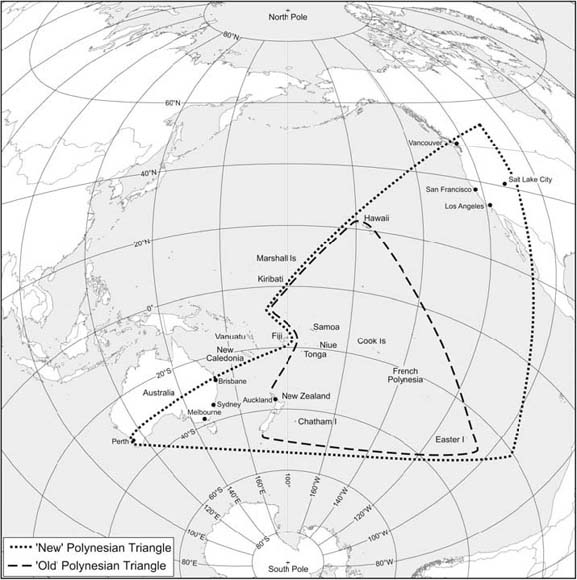
     In our discussion of the fluidity of culture across the ocean, I became curious about the islands in the Pacific that are frequently forgotten or disregarded because of the heavy influence of mainland continental powers on the sea routes. So, I decided to look into some examples of groups who are heavily influenced by colonization and who use the Pacific Ocean for migration and general cultural movement, in order to find similar patterns of colonized cultural appropriation and re-interpretation similar to those seen in the Black Pacific culture. The article of interest to me, New Polynesian Triangle: Rethinking Polynesian migration and development in the Pacific focused on Polynesians and redefining migration in terms other than what has been used in the past. Because the Polynesians were not violently enslaved, these patterns and causes are a little different than those of Black Pacific culture. However, I found the article to not only agree with some of the points we've been making in class but has also expanded on some of them as well. Specifically, the discussions about the empirical cultural influences on the Polynesian culture of the homeland and how these cultures mix and intertwine with other aspects of cultural influence, such as the influences from a different small island that is not the home nation but offers other benefits because it is also colonized. In short, the discussions about how the fluidity of the ocean effects the fluidity of acquiring cultural habits other than one's own, and how the decision (conscious or not) to acquire cultural habits is reached.
    The article focuses on the idea that rather than economic based reasons, "social- cultural factors can be seen as framing many decisions made about migration, and political dimensions also need to be considered (Afolayan, 2001)." Some factors mentioned that have a strong influence are namely religion, social benefits such as education, and personal benefits such as health. The Polynesians are a group of people who have a relative amount of choice in their decision for migration (since they aren't violently enslaved) however, the colonization of this culture has contributed greatly to the culture's trajectory. One interesting pattern of the Polynesian people is their demonstration of a high return migration rate, something I believe happens because of other social factors including feeling a sense of belonging. Although the Polynesians were doing well for themselves when the empirical nations had strong command of the economy, once that economy began to fail, the incentive of a "new" sense of belonging to the culture of the new location is not appealing when there are not economic benefits. It seems that social-cultural factors have a far greater influence on the choice of migration over economic opportunity. This pattern obviously differs from the case of the Blacks whose cultural movement was not based on their own economic/social/cultural interest but the interest of empirical others. This idea caused me to raise a different critical question about the culture of the Black Pacific: the preservation of African cultural habits in slaves being shipped occurs through music or other small hints of culture, such as is described in "Benito Cereno," but are the reasons for this preservation due to a sensation of comfort for the traumatized individual because of their lack of free-will, or is it due to a desire of social-cultural interest rather than acquiring a "new" sense of culture? Is it a harmless but deliberate attempt to not acquire outside cultural influence by preserving your own or is it a method of coping? Both?