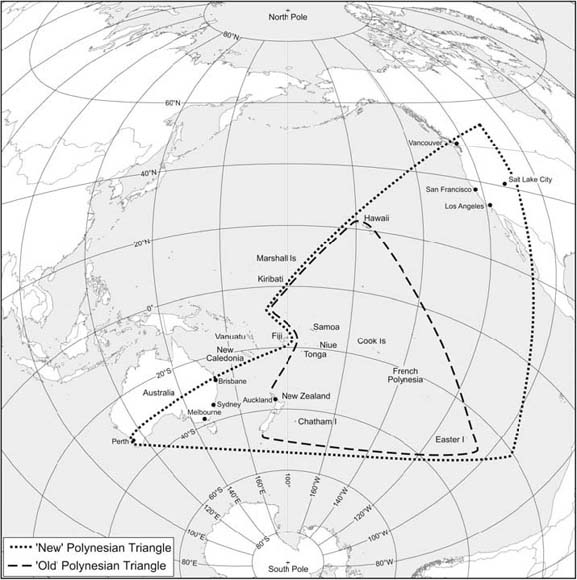
In our discussion of the fluidity of culture across the ocean, I became curious about the islands in the Pacific that are frequently forgotten or disregarded because of the heavy influence of mainland continental powers on the sea routes. So, I decided to look into some examples of groups who are heavily influenced by colonization and who use the Pacific Ocean for migration and general cultural movement, in order to find similar patterns of colonized cultural appropriation and re-interpretation similar to those seen in the Black Pacific culture. The article of interest to me, New Polynesian Triangle: Rethinking Polynesian migration and development in the Pacific focused on Polynesians and redefining migration in terms other than what has been used in the past. Because the Polynesians were not violently enslaved, these patterns and causes are a little different than those of Black Pacific culture. However, I found the article to not only agree with some of the points we've been making in class but has also expanded on some of them as well. Specifically, the discussions about the empirical cultural influences on the Polynesian culture of the homeland and how these cultures mix and intertwine with other aspects of cultural influence, such as the influences from a different small island that is not the home nation but offers other benefits because it is also colonized. In short, the discussions about how the fluidity of the ocean effects the fluidity of acquiring cultural habits other than one's own, and how the decision (conscious or not) to acquire cultural habits is reached.
The article focuses on the idea that rather than economic based reasons, "social- cultural factors can be seen as framing many decisions made about migration, and political dimensions also need to be considered (Afolayan, 2001)." Some factors mentioned that have a strong influence are namely religion, social benefits such as education, and personal benefits such as health. The Polynesians are a group of people who have a relative amount of choice in their decision for migration (since they aren't violently enslaved) however, the colonization of this culture has contributed greatly to the culture's trajectory. One interesting pattern of the Polynesian people is their demonstration of a high return migration rate, something I believe happens because of other social factors including feeling a sense of belonging. Although the Polynesians were doing well for themselves when the empirical nations had strong command of the economy, once that economy began to fail, the incentive of a "new" sense of belonging to the culture of the new location is not appealing when there are not economic benefits. It seems that social-cultural factors have a far greater influence on the choice of migration over economic opportunity. This pattern obviously differs from the case of the Blacks whose cultural movement was not based on their own economic/social/cultural interest but the interest of empirical others. This idea caused me to raise a different critical question about the culture of the Black Pacific: the preservation of African cultural habits in slaves being shipped occurs through music or other small hints of culture, such as is described in "Benito Cereno," but are the reasons for this preservation due to a sensation of comfort for the traumatized individual because of their lack of free-will, or is it due to a desire of social-cultural interest rather than acquiring a "new" sense of culture? Is it a harmless but deliberate attempt to not acquire outside cultural influence by preserving your own or is it a method of coping? Both?

The article focuses on the idea that rather than economic based reasons, "social- cultural factors can be seen as framing many decisions made about migration, and political dimensions also need to be considered (Afolayan, 2001)." Some factors mentioned that have a strong influence are namely religion, social benefits such as education, and personal benefits such as health. The Polynesians are a group of people who have a relative amount of choice in their decision for migration (since they aren't violently enslaved) however, the colonization of this culture has contributed greatly to the culture's trajectory. One interesting pattern of the Polynesian people is their demonstration of a high return migration rate, something I believe happens because of other social factors including feeling a sense of belonging. Although the Polynesians were doing well for themselves when the empirical nations had strong command of the economy, once that economy began to fail, the incentive of a "new" sense of belonging to the culture of the new location is not appealing when there are not economic benefits. It seems that social-cultural factors have a far greater influence on the choice of migration over economic opportunity. This pattern obviously differs from the case of the Blacks whose cultural movement was not based on their own economic/social/cultural interest but the interest of empirical others. This idea caused me to raise a different critical question about the culture of the Black Pacific: the preservation of African cultural habits in slaves being shipped occurs through music or other small hints of culture, such as is described in "Benito Cereno," but are the reasons for this preservation due to a sensation of comfort for the traumatized individual because of their lack of free-will, or is it due to a desire of social-cultural interest rather than acquiring a "new" sense of culture? Is it a harmless but deliberate attempt to not acquire outside cultural influence by preserving your own or is it a method of coping? Both?

This comment has been removed by the author.
ReplyDelete